Quick Answer: HDB estimates that PVC electrical cables last about 25 years, so most flats older than that should be assessed for rewiring. Warning signs include frequent tripping, warm or discoloured sockets, flickering lights and a burning smell. Full rewiring of a 4-room HDB flat typically costs about $3,000 to $5,500 in 2026. All wiring must be done by an EMA-licensed electrical worker. Flats with a 40-amp main switch don’t need an HDB permit for rewiring or new points. Flats with a 30-amp main switch need a permit for new 15A power points or 20A air-conditioner isolators.
Electrical wiring is easy to forget during a renovation because you never see it. But it powers everything from your air-conditioners and induction hob to your water heater and washing machine. In older flats, ageing wiring is one of the most common hidden safety risks.
At Han Yong, we check the electrical condition of every resale flat before we propose a design. In this guide, we explain when an HDB rewiring job is needed, what it costs, which HDB rules apply and how to plan it properly.
Why Rewiring Matters in Older HDB Flats
HDB estimates the average lifespan of PVC electrical cables at about 25 years. After that, the insulation around the wires can harden, crack or deteriorate, especially in Singapore’s heat and humidity. HDB advises owners to replace the wiring once its lifespan is over or its condition has deteriorated.
Modern households also use far more electricity than when many older flats were built. Multiple air-conditioners, ovens, induction hobs, instant water heaters, dryers and home-office equipment all add load to circuits that were never designed for them.
Old or overloaded wiring can lead to:
- Overheating cables and fire risk
- Frequent circuit breaker trips
- Damage to sensitive appliances
- Electric shock risk from worn insulation
Warning Signs Your Flat Needs Rewiring
Ask a licensed electrical worker to assess your flat if you notice any of these:
- Frequent tripping of the main switch or circuit breakers
- Warm, discoloured or scorched sockets and switches
- Flickering or dimming lights when appliances switch on
- A burning or plastic smell near sockets or the distribution board
- Buzzing sounds from switches or the DB box
- Old-style fuses or an outdated distribution board
- Not enough power points, leading to heavy use of extension cords
- The flat is over 25 years old and has never been rewired
If you are buying a resale flat, include an electrical check in your inspection. It is far cheaper to rewire before carpentry and painting than after.
30A vs 40A Main Switch: Why It Matters
Your flat’s main switch rating decides what electrical work you can do and whether you need a permit. You can check your block’s electrical loading on HDB’s website.
If your flat still has a 30A main switch and you plan to install several air-conditioners and high-power appliances, discuss the load with your electrical worker early. It affects both your permit application and your appliance choices.
HDB Rules for Electrical Works
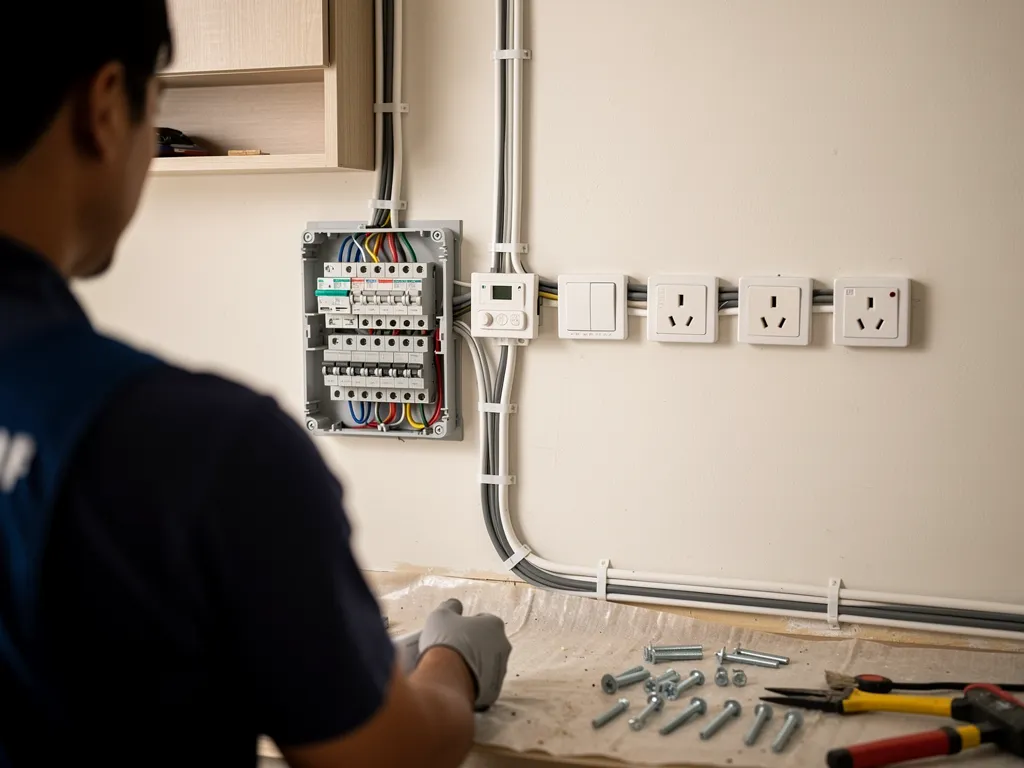
HDB’s electrical works guidelines set out clear conditions:
- Licensed workers only: All electrical wiring must be installed by an electrical worker licensed by the Energy Market Authority (EMA).
- No wiring embedded in structure: Wiring in metal or high-impact PVC conduit must not be embedded in reinforced concrete slabs, beams, columns or walls, or in the plaster.
- Use trunking or surface conduit: New wiring is usually run in PVC trunking or concealed behind carpentry and false ceilings.
- Concealed wiring: In flats with HDB’s original concealed wiring, take care when drilling so anchors and nails stay clear of the conduits.
- SP Services testing: New wiring and wiring extensions must be tested. Your electrical worker submits the required form (CS/5H, endorsed by HDB) and arranges the inspection.
- Exhaust fans: These are allowed in bathrooms only.
- TV points: Relocation must be done by an approved cable installer.
Works that don’t follow these guidelines are unauthorised, and HDB can require you to remove them or reinstate the flat. For the full list of permit rules, read our HDB renovation permit guide.
Ready to Recreate Your Living Space? Book an appointment today! Get a Customised Estimate →
How Much Does HDB Rewiring Cost in 2026?
Prices depend on flat size, number of points, the distribution board and access. Typical 2026 market estimates:
3-room flats usually cost less and 5-room or executive flats more. Older flats over 30 years old may cost more because of extra trunking and making good. Rewiring is one of the hidden costs we highlight in our HDB renovation cost guide.
When Should You Rewire?
The best time to rewire is during a full renovation, before carpentry, false ceilings and painting. At that stage:
- Walls and ceilings are already open, so trunking can be hidden neatly
- Power points can be planned around your new furniture layout
- You avoid damaging new carpentry and paint later
- Air-conditioner isolators and trunking can be installed at the same time
When planning, think ahead about where you’ll need power: bedside charging, kitchen appliances, a home office, the TV wall and outdoor or service-yard points. Our master bedroom layout tips include ideas for placing bedside sockets and lighting.
Rewiring Process: What to Expect
- Assessment: A licensed electrical worker inspects the DB box, wiring condition and load requirements.
- Layout planning: New power, lighting and isolator points are marked on your renovation plan.
- Permit (if needed): For 30A flats adding 15A points or 20A isolators, your contractor applies for an HDB permit.
- Installation: Old wiring is replaced and new wiring is run in trunking, conduit or behind carpentry.
- DB box upgrade: Circuit breakers and RCCB/ELCB protection are installed or upgraded.
- Testing: New wiring is tested and inspected as required before it is used.
A full rewiring usually takes a few days of site work, depending on flat size.
Rewire Your Flat Safely With Han Yong
At Han Yong, electrical safety comes before aesthetics. As an HDB-licensed contractor (licence no. HB-02-0289A) with over 10 years of experience, we work with licensed electrical workers, apply for any required HDB permits and plan your power points around your new layout.
Our four-step process of Consult, Propose, Develop and Reveal gives you a Letter of Agreement with itemised electrical costs and a milestone payment schedule. Explore our HDB renovation, kitchen renovation and condo renovation projects. You can also read why compliance and certification matter, or learn more about us.
Before you sign any electrical quote, see how to read it in our renovation quotation guide.
Sign-up to our Four-Step Property Renovation Plan Today! Get your flat’s wiring assessed before you renovate. Get a Customised Estimate →
Frequently Asked Questions
How often should HDB flats be rewired?
HDB estimates PVC electrical cables last about 25 years. If your flat is older than that or shows warning signs like frequent tripping or warm sockets, ask a licensed electrical worker to assess whether rewiring is needed.
How much does it cost to rewire a 4-room HDB flat?
Full rewiring of a 4-room HDB flat typically costs about $3,000 to $5,500 in 2026. The final cost depends on the number of points, the distribution board upgrade and how the wiring is concealed.
Do I need an HDB permit to rewire my flat?
Rewiring and adding lighting or 13A power points don’t need a permit, but the work must follow HDB’s guidelines. Flats with a 30A main switch need a permit for new 15A power points or 20A air-conditioner isolators.
How do I know if my flat has a 30A or 40A main switch?
Blocks completed from 1 January 1994, and older blocks upgraded under MUP or HIP, generally have a 40A main switch. You can check your block’s electrical loading on HDB’s website or look at the rating on your main switch.
Can any electrician rewire my HDB flat?
No. All electrical wiring in HDB flats must be installed by an EMA-licensed electrical worker. Ask to see the licence before work starts.
Can I hide new wiring inside the walls?
Wiring must not be embedded in reinforced concrete slabs, beams, columns or walls, or in the plaster. It is usually run in PVC trunking, concealed behind carpentry or hidden above a false ceiling.